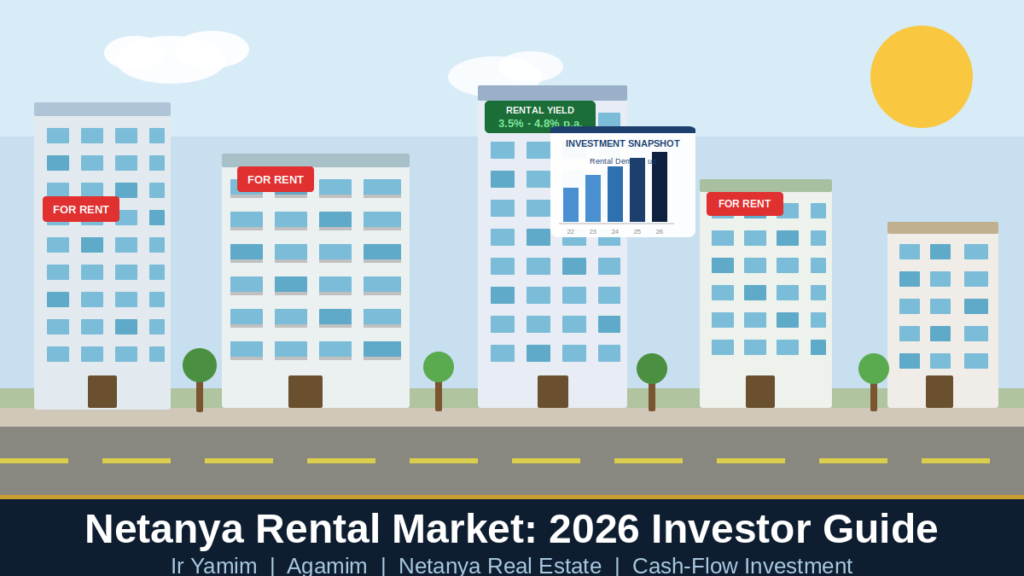
Netanya’s coastal high-rises: a steady rental market anchored by strong local demand from young families, professionals, and an established expatriate community.
If you are evaluating Netanya real estate as a cash-generating investment, one data point stands above the rest: Netanya’s rental market demand has remained consistently high for over a decade – and structural factors suggest it will stay that way. This guide breaks down the numbers behind that demand, identifies the premium neighbourhoods where investors see the strongest returns, and explains exactly why purchasing Netanya property for sale is one of the most defensible real-estate plays available to overseas buyers in Israel today.
Why Rental Demand in Netanya Refuses to Cool
Netanya is not a seasonal market. Unlike resort towns that fill in August and empty in October, the city maintains a year-round base of renters drawn from several distinct pools:
- Young Israeli families and professionals: The city’s expanding commercial district, tech satellite offices, and proximity to the Tel Aviv employment corridor draw thousands of working residents who are either priced out of home ownership or choosing to rent while they wait for the right purchase opportunity.
- France’s largest Israeli diaspora: Netanya hosts the largest French-speaking community outside Paris, and a significant share of French arrivals rent for one to three years before deciding whether to purchase – creating a permanent pipeline of high-quality tenants.
- New immigrants (olim chadashim): Israel’s ongoing aliyah wave brings in educated, income-earning newcomers who typically rent for their first two to five years while establishing residency, language, and local networks.
- Short-stay international visitors: Platforms like Airbnb and short-let agencies have made coastal Netanya – especially Ir Yamim and Poleg – a consistently booked destination for European and North American visitors who want more than a hotel room.
The Headline Numbers
Gross rental yields in Netanya’s premium neighbourhoods currently range between 3.2% and 4.8% per annum, depending on property type, floor, and proximity to the sea. While those figures may appear modest against other European markets, they come with a fundamentally different risk profile: a stable rule-of-law environment, a strong shekel tied to a resilient economy, and property values that have historically appreciated at an average of 5-8% annually over the past decade. Combined, the total annual return picture for well-selected Netanya assets is compelling for investors with a 5-to-10-year horizon.
A practical yield snapshot by segment:
- 2-bedroom apartment in Agamim, mid-floor, no sea view: gross yield ~3.8%-4.2%
- 3-bedroom apartment in Ir Yamim, high floor, partial sea view: gross yield ~3.5%-4.0%
- 1-bedroom studio near city centre: gross yield ~4.2%-4.8%
- Short-let/Airbnb-optimised seafront unit: gross yield 5%-7% (higher management overhead)
Ir Yamim Netanya: The Premium Rental Powerhouse
Ir Yamim Netanya is consistently the most requested neighbourhood among international investors – and for good reason. The district was purpose-built as a self-contained urban environment, with a large shopping mall, schools, clinics, parks, and direct access to a protected beach. For renters, it offers the convenience of a complete neighbourhood ecosystem without a car. For investors, this means extremely low vacancy rates: well-presented 3- and 4-bedroom apartments in Ir Yamim are typically let within two to four weeks of listing, and lease renewals run at unusually high rates, reducing the gap between tenancies.
Another advantage specific to Ir Yamim is the depth of the qualified tenant pool. The neighbourhood attracts dual-income families with stable employment – the kind of tenants who pay on time, maintain properties well, and commit to multi-year leases. For a foreign investor managing remotely, this dramatically reduces operational risk.
Agamim Netanya: Steady Yield, Lower Entry Point
Agamim Netanya offers a different but equally compelling investment case. Situated in the heart of the city with green park-side streets and excellent public transport links, Agamim attracts long-term tenants who value community stability over beachfront glamour. Entry prices are materially lower than Ir Yamim, which means investors can achieve comparable or slightly higher yields on a smaller capital outlay.
The neighbourhood’s demographic profile – predominantly established families, returning Israelis, and French-speaking long-term residents – means tenant turnover is low and lease durations average 18-24 months. For investors seeking a lower-volatility, income-focused asset, Agamim is frequently the better fit than a higher-profile seafront tower.
What Remote Investors Need to Get Right
Buying investment property in Israel from abroad is entirely achievable – thousands of foreign nationals do it every year – but it requires the right structure from day one. Key considerations include:
- Local property management: A professional management company handles tenant screening, lease execution, maintenance calls, and rent collection. Fees typically run 8-12% of monthly rent – a cost that should be built into your yield modelling from the start.
- Tax registration: Non-resident landlords in Israel are taxed on rental income, but a favourable flat-rate option of 15% exists for those who do not claim expenses. Your tax adviser should determine the optimal approach before the first lease is signed.
- Currency and repatriation: Rental income is paid in New Israeli Shekels (NIS). Specialist currency services offer significantly better rates than bank wire transfers for converting and repatriating income – a difference that compounds meaningfully over time.
- Choosing the right property: Not every unit in a desirable neighbourhood is a strong rental asset. Floor height, building committee quality, parking, and proximity to schools all influence tenant quality and rental velocity. Working with advisers who know the buildings is non-negotiable.
For a neutral, data-backed overview of Israel’s property market fundamentals, the Bank of Israel’s housing market publications provide authoritative context on price trends, mortgage data, and regulatory shifts.
Frequently Asked Questions
- What rental yields can I realistically expect from a Netanya investment property?
Gross rental yields in Netanya’s premium neighbourhoods currently range between 3.2% and 4.8% per annum, depending on location, floor height, and property type. Seafront units optimised for short-let platforms can reach 5%-7%, though these come with higher management overhead. When combined with the city’s historical capital appreciation of 5–8% annually, the total return picture is strong for investors with a 5-to-10-year horizon.
- Which Netanya neighbourhood offers the best rental investment – Ir Yamim or Agamim?
The answer depends on your investment profile. Ir Yamim delivers extremely low vacancy rates, a deep pool of dual-income family tenants, and premium positioning – but entry prices are higher. Agamim offers a lower entry point with comparable or slightly stronger yields, longer average lease durations of 18–24 months, and a stable, community-rooted tenant base. Both neighbourhoods are strong performers; the right choice depends on your capital outlay and appetite for active management.
- Can I buy a rental property in Netanya without visiting Israel in person?
Yes. Thousands of foreign nationals complete Israeli property purchases remotely every year. The standard process involves granting your Israeli lawyer a notarised Power of Attorney, conducting structured live video walkthroughs, and using specialist currency services for the funds transfer. Working with an experienced local agency and a licensed Israeli real estate lawyer from the outset is essential to doing this safely.
- How is rental income from an Israeli property taxed for foreign investors?
Non-resident landlords in Israel are subject to tax on rental income. A favourable flat-rate option of 15% is available for investors who do not claim deductible expenses – which is often the most efficient route for overseas owners. Your tax adviser should assess your specific situation before the first lease is signed, as the optimal approach varies depending on your country of residence and any applicable tax treaties with Israel.
- What property management costs should I factor into my yield calculation?
Professional property management in Israel typically costs 8-12% of monthly rent. This covers tenant screening, lease execution, maintenance coordination, and rent collection. For a remote investor, this fee is not optional – it is the operational infrastructure that makes the investment function. Build it into your yield model from day one, alongside municipal tax (arnona), building committee fees, and occasional maintenance provisions.
- Is Netanya’s rental demand stable year-round, or is it seasonal?
Netanya operates as a genuine year-round rental market, not a seasonal one. Its tenant base draws from multiple permanent pools: young Israeli families and professionals, a large and established French-speaking diaspora, new immigrants who typically rent for two to five years upon arrival, and international visitors using short-let platforms. This structural diversity insulates the market from the vacancy risks that affect purely tourism-driven coastal destinations.
The Investment Case in Summary
Netanya’s rental market demand is not a trend – it is a structural feature of a city that has been absorbing population growth, international arrivals, and domestic migration for over thirty years. The combination of a deep, diverse tenant pool, solid yield fundamentals, and a track record of capital appreciation makes the city’s premium neighbourhoods – particularly Ir Yamim and Agamim – an investment destination that belongs in any serious international real-estate portfolio. To explore current available assets and get a detailed investment briefing tailored to your budget and return objectives, contact the team at Home In Israel.
