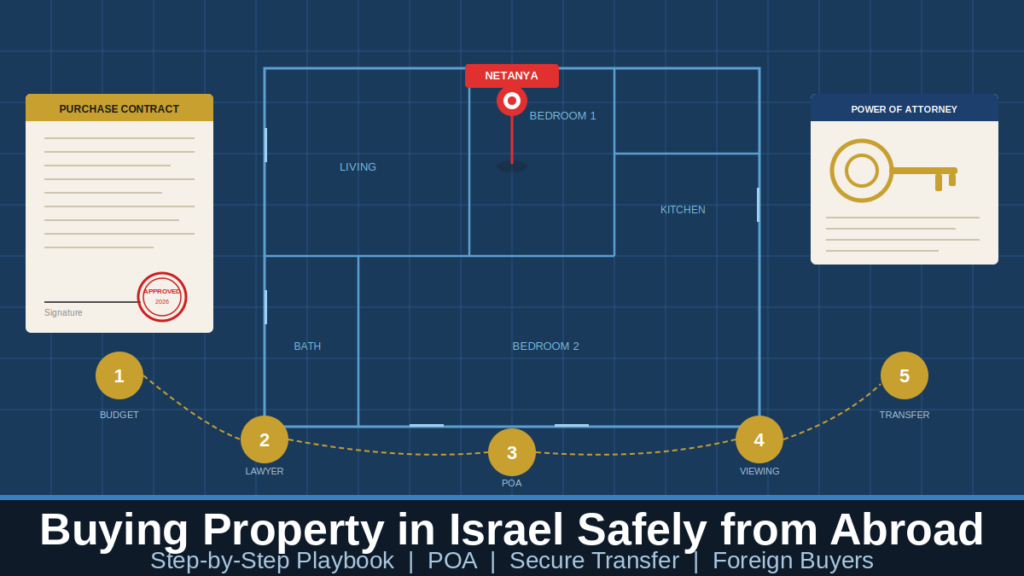
Buying property in Israel from abroad is no longer the high-friction process it was a decade ago. Thousands of foreign nationals complete Israel property purchases every year without setting foot in the country during the transaction itself. But doing it safely – protecting your deposit, ensuring legal title is clean, and knowing exactly how much an apartment costs in Netanya before you make an offer – requires a clear, sequenced approach. This playbook walks you through every step, from first search to keys in hand, with specific guidance for buyers targeting apartments for sale in Netanya and those considering private houses for sale in Netanya.
Step 1: Anchor Your Budget to Real Market Data
Before you shortlist a single property, you need an accurate, current picture of Netanya apartment prices – not the figures from a three-year-old article or a developer’s marketing deck.
As of 2026, the broad price ranges for the Netanya market are:
- 1-bedroom apartment (40-55 sqm), inland location: ILS 1.1M-1.6M (approx. USD 290K-420K)
- 2-bedroom apartment (65-80 sqm), mid-market neighbourhood: ILS 1.6M-2.4M (approx. USD 420K-630K)
- 3-bedroom / 4-room apartment, established neighbourhood: ILS 2.2M-3.5M (approx. USD 580K-920K)
- 3-bedroom apartment, Ir Yamim or seafront with partial sea view: ILS 3.2M-4.8M (approx. USD 840K-1.26M)
- Private house / villa (Ramat Poleg or Ramat Efrayim): ILS 4.5M-9M+ (approx. USD 1.18M-2.36M+)
These ranges are orientation figures only. The actual Netanya apartment prices you encounter will be influenced by building quality, floor, sea view, parking, and building committee performance. A professional appraisal is essential before any offer.
Step 2: Appoint a Licensed Israeli Lawyer – Before Anything Else
This step is non-negotiable and should happen before you view a single property, sign anything, or transfer a single shekel. An Israeli real estate lawyer acts as your primary safeguard throughout the transaction. Their responsibilities include:
- Conducting a full title search (tabu / land registry) to confirm ownership, encumbrances, liens, and planning status
- Reviewing and negotiating the purchase contract on your behalf
- Verifying building permits and checking for unauthorised construction
- Managing the secure escrow-style holding of your deposit until conditions precedent are met
- Filing the required purchase tax declarations and registering the transfer with the Israel Land Authority
Legal fees in Israel typically run 0.5%-1.5% of the purchase price plus VAT. Referrals to vetted legal professionals who regularly represent foreign buyers are available through the team at Home In Israel.
Step 3: Grant a Power of Attorney (POA)
Because you are buying remotely, your lawyer will need a notarised Power of Attorney (POA) – a legal document authorising them to sign documents and act on your behalf in Israel. The process is straightforward:
- Visit an Israeli embassy, consulate, or a notary public in your country of residence
- Sign the POA document (which your Israeli lawyer will draft and send to you) in the presence of the notary
- Have the document apostilled (if your country is a Hague Convention signatory) or legalised through the appropriate diplomatic channel
- Send the original to your Israeli lawyer – digital copies are not sufficient for land registry filings
The POA process typically takes 5-15 working days depending on your jurisdiction. Factor this into your timeline before making an offer, as most Israeli purchase contracts require a signed POA to be in place within a specified period.
Step 4: Conduct Remote Property Viewings the Right Way
Remote viewings have evolved significantly. A WhatsApp video call with a seller walking through a unit is no longer adequate for a purchase of this scale. The professional standard now includes:
- Structured live video walkthroughs: Your agent conducts a systematic walkthrough of every room, every view angle, the building entrance, the parking space, and the roof – with you on a live call, able to pause, ask, and redirect.
- Independent building inspection: A licensed Israeli building inspector physically inspects the property and provides a written report covering structural integrity, moisture, electrical, plumbing, and compliance with building permits. This report is sent to you before you commit.
- Neighbourhood documentation: Your agent provides street-level video footage of the surrounding area at different times of day – crucial for assessing noise, parking, access, and the character of the immediate environment.
- Virtual meeting with the building committee chair: For apartment purchases, a brief call with the va’ad bayit chair can reveal critical information about building maintenance, disputes, and planned expenditure that will not appear in any listing.
Step 5: Secure Your Funds Transfer and Currency Exchange
Moving large sums internationally for a property purchase involves both regulatory compliance and significant cost-optimisation opportunities that most buyers ignore.
- Anti-money laundering (AML) documentation: Israeli banks and your lawyer are required to verify the legitimate source of funds. Prepare a clear funds-trail documentation package – bank statements, salary slips, sale-of-asset documentation, or inheritance paperwork – before the transfer.
- Use a specialist currency service: Banks typically charge 2-4% above the mid-market exchange rate on international transfers. Specialist FX services can reduce this to 0.3-1.5%, saving tens of thousands on a multi-million-shekel purchase.
- Forward contracts: If there is a gap between offer acceptance and completion, consider a forward contract with your FX provider – locking in today’s exchange rate against a future settlement date. This eliminates currency risk during the transaction period.
- Israeli bank account: For ongoing management costs, municipal taxes, and eventual rental income, opening an Israeli bank account simplifies operations considerably. Your lawyer can advise on the optimal setup for non-residents.
Step 6: Understand Purchase Tax (Mas Rechisha)
Foreign nationals are subject to purchase tax on the transaction value. As of 2026, the standard brackets for foreign buyers are:
- Up to ILS 5,872,725: 8%
- Above ILS 5,872,725: 10%
Your lawyer will calculate the exact liability and include it in your total cost modelling. For a neutral reference on Israel’s tax framework, the Israel Tax Authority publishes current brackets and exemptions.
Step 7: From Signed Contract to Registered Title
Once your lawyer has completed due diligence and negotiated the final contract, the transaction proceeds in stages:
- Initial deposit (typically 10%): Paid into your lawyer’s client account upon contract signing. Held in trust and released to the seller against compliance with contract conditions.
- Stage payments (if new-developer project): Linked to construction milestones, each backed by a bank guarantee as required by Israel’s Sale Law – your statutory protection if the developer defaults.
- Final payment and key handover: Balance is paid upon confirmed title clearance. Your lawyer registers the transfer with the Israel Land Authority, and you become the registered owner.
- Post-completion: Municipal tax registration, building committee notification, utility account transfers, and – if relevant – engagement of a property management company for rental activation.
The Full Cost Stack: What You Actually Pay Beyond the Purchase Price
Overseas buyers frequently underestimate total acquisition cost. A realistic full cost model for a Netanya purchase includes:
- Purchase price (the listed or negotiated amount)
- Purchase tax (Mas Rechisha): 8%-10% for foreign nationals
- Legal fees: 0.5%-1.5% + VAT
- Agent commission: typically 2% + VAT (both buyer and seller commonly pay agent fees in Israel)
- Building inspection: ILS 1,500-3,500
- Notary / apostille for POA: varies by country
- Currency conversion costs: 0.3%-4% depending on method
- Mortgage arrangement fees (if applicable): 0.25%-1% of loan amount
Total acquisition costs beyond the purchase price typically run 11%-15% for foreign nationals. Build this into your financial model from day one.
Frequently Asked Questions
- Do I really need to visit Israel in person to buy a property there?
No. Buying property in Israel from abroad without visiting in person is a well-established, legally sound process that thousands of foreign nationals complete successfully every year. The key instruments that make this possible are a notarised Power of Attorney, structured live video walkthroughs conducted by your agent, an independent building inspection with a written report, and a licensed Israeli lawyer managing the legal process on your behalf. The transaction is entirely executable remotely when the right professional team is in place. - How much does an apartment cost in Netanya in 2026?
Price ranges vary significantly by size, neighbourhood, and proximity to the sea. As a broad orientation: a 1-bedroom inland apartment starts from around ILS 1.1M (approx. USD 290K), a 2-bedroom mid-market unit runs ILS 1.6M-2.4M (approx. USD 420K-630K), and a 3-bedroom apartment in a premium location such as Ir Yamim with a partial sea view can reach ILS 3.2M-4.8M (approx. USD 840K-1.26M). Private houses and villas in areas like Ramat Poleg start from ILS 4.5M and rise significantly from there. These are orientation figures – a professional appraisal is essential before any offer. - What is a Power of Attorney and why do I need one as a remote buyer?
A Power of Attorney (POA) is a legally binding document that authorises your Israeli lawyer to sign documents and take actions on your behalf during the transaction. Because you are not physically present in Israel, the POA allows your lawyer to execute the purchase contract, file tax declarations, and register the title transfer with the Israel Land Authority without requiring your signature in person. The document must be notarised in your country of residence, apostilled if applicable, and the original sent to your lawyer – digital copies are not accepted for land registry purposes. - What purchase tax will I pay as a foreign buyer in Israel?
Foreign nationals purchasing property in Israel are subject to Mas Rechisha (purchase tax) at the following rates as of 2026: 8% on the portion of the purchase price up to ILS 5,872,725, and 10% on any amount above that threshold. Unlike Israeli citizens purchasing their first home, foreign nationals do not benefit from the reduced lower-bracket rates. Your lawyer will calculate the exact liability and incorporate it into your total cost model before you commit. - What are the total acquisition costs beyond the purchase price?
Foreign buyers should budget for an additional 11%-15% on top of the purchase price to cover all acquisition costs. These include purchase tax (8%-10%), legal fees (0.5%-1.5% plus VAT), agent commission (typically 2% plus VAT, payable by both buyer and seller in Israel), a building inspection (ILS 1,500-3,500), notary and apostille fees for the POA, and currency conversion costs (0.3%-4% depending on the method used). Mortgage arrangement fees add a further 0.25%-1% of the loan amount if financing is involved. - How do I protect my deposit when buying remotely?
Your deposit is protected through your Israeli lawyer’s client account, where it is held in trust and released to the seller only once all contractual conditions precedent have been satisfied. For new-developer purchases, each stage payment is backed by a statutory bank guarantee under Israel’s Sale Law, which protects you in the event the developer defaults or fails to deliver. Never transfer funds directly to a seller or developer without your lawyer’s involvement and confirmation that the appropriate protections are in place. - How long does the remote buying process typically take from first search to registered ownership?
The timeline varies depending on whether you are buying a resale property or a new-developer unit. A resale transaction in Israel typically completes within 60-120 days from offer acceptance to registered title transfer, assuming due diligence proceeds without complications. New-developer purchases can take considerably longer if the project is under construction, with stage payments linked to completion milestones. The POA process alone requires 5-15 working days, so factor this into your timeline before making a formal offer.
Final Word: The Right Team Makes All the Difference
Buying property in Israel from abroad is a structured, well-established process that thousands of buyers complete successfully every year. The difference between a smooth transaction and an expensive mistake almost always comes down to the quality of the professional team assembled before the first offer is made.
At Home In Israel, we work with international buyers at every stage – from initial neighbourhood shortlisting and remote viewings through to legal referrals, management setup, and beyond. To begin your search for apartments for sale in Netanya, contact our team for a no-obligation consultation.
